Spoilers ahead.
There is a moment in Ridley Scott's Alien (1979) that deserves more attention than almost any appearance of the creature itself.
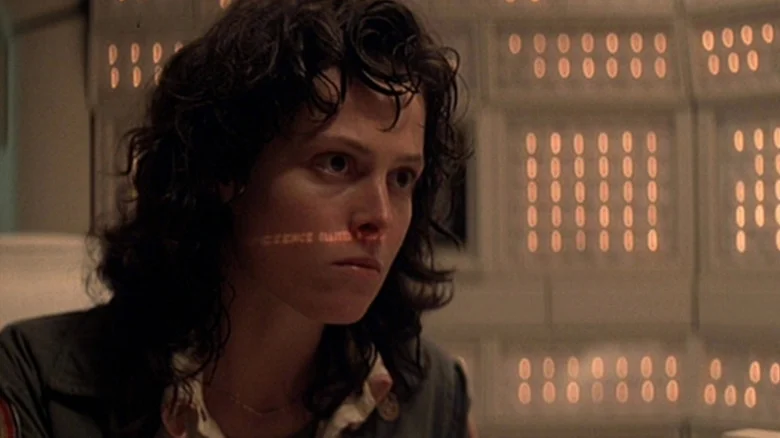
Ellen Ripley is running out of time. She has activated the Nostromo's self-destruct sequence, intending to destroy the alien along with the ship. But the creature has blocked her escape. She rushes back to the engine room, restores the cooling system, and desperately attempts to cancel the destruction.
The ship's computer, affectionately called Mother, answers:
"The ship will automatically destruct in T minus five minutes."
Ripley stares at the terminal.
"You... BITCH!"
She attacks the screen with her flamethrower.
The scene lasts only moments. Yet hidden inside it is a question that has become considerably more interesting in the age of artificial intelligence.
Why does Mother refuse to change her mind?
And, perhaps more importantly, what makes us assume that she has a mind to change?
Before the machine learned to think
To understand Mother, we need to return to a period when computers were expected to become something extraordinary.
In 1949, Edmund Berkeley published Giant Brains: Or, Machines That Think. The title captured the technological optimism of the postwar era. Computers were no longer merely calculating devices. They were becoming electronic brains.
Norbert Wiener's cybernetics had already established important connections between machines, control, communication, and biological systems.
Then, in 1956, researchers gathered at Dartmouth College for the summer project that formally established artificial intelligence as a field of research. Their ambition was remarkable: to investigate whether the processes underlying intelligence could be described precisely enough for machines to reproduce them.
The following decades brought increasingly confident predictions.
By 1968, Stanley Kubrick had given audiences HAL 9000 in 2001: A Space Odyssey: a computer capable of conversation, apparent emotional responses, and decisions that ultimately threatened human life.
Even popular magazines were introducing readers to the possibilities of machine intelligence. In November 1970, National Geographic published "Behold the Computer Revolution," featuring, among other developments, Shakey, an experimental robot capable of planning movements through its environment.
Artificial intelligence was not an unfamiliar concept when Alien was developed.
Yet by the middle of the 1970s, much of the early enthusiasm had encountered reality.
The influential Lighthill Report of 1973 challenged ambitious claims about AI research, contributing to the loss of confidence and funding later associated with the first AI winter.
Promises of humanlike machine intelligence had proved considerably easier to make than to fulfill.
Alien emerged from this changing intellectual climate.
Its computer was different from HAL.
Mother did not engage the crew in elaborate philosophical conversations. She communicated through terminals, displays, instructions, and prerecorded-sounding announcements. Her authority seemed administrative rather than personal.
We might be tempted to describe her as a sophisticated rule-based system, closer to classical automation than to the autonomous intelligence imagined by science fiction.
But there is an important distinction here. Rule-based expert systems were themselves part of AI research. Deterministic execution does not necessarily exclude intelligence, and intelligence does not imply consciousness.
The interesting question is therefore not whether Mother technically qualifies as AI.
It is whether she can recognize when following an instruction has become incompatible with the purpose of that instruction.
And that brings us to a secret hidden aboard the Nostromo.
The mother with two loyalties
Mother performs the functions we would expect from a ship's central computer. She monitors systems, processes information, supports navigation, and helps maintain the conditions necessary for the crew's survival.
Her name suggests care.
The crew sleeps under her supervision. She wakes them when necessary. She communicates with them in a manner that invites the illusion of a protective presence.
A mother can say no, of course.
But we expect an actual mother to understand what her refusal means. We expect judgment, contextual understanding, perhaps even the willingness to reconsider a decision when circumstances change.
Mother offers no such assurance.
As Ripley eventually discovers, the computer's operational priorities are not what the crew has been led to believe.
Special Order 937 instructs the ship to secure the alien organism for analysis. Its chilling final qualification is:
"Crew expendable."
The commercial mission is subordinate to a concealed corporate objective.
The crew's survival is not the overriding concern.
The company has effectively introduced two different understandings of the mission: one communicated to the people performing it, another embedded in the systems controlling it.
This is more disturbing than a computer deciding independently to become evil.
The machine may be doing precisely what its owners intended.
The horror does not require artificial malice. Institutional priorities are sufficient.
And yet there appears to be a contradiction.
A contradiction so fundamental that it threatens to undermine our entire understanding of Mother.
The fatal contradiction
Consider what happens near the end of the film.
Mother's hidden priority is to ensure the organism's return for analysis.
Ripley activates the self-destruct system.
Then, when her escape is obstructed, she attempts to reverse her decision.
Mother refuses.
The countdown continues.
At first glance, something is terribly wrong with the computer's logic.
If the organism is still aboard the Nostromo, destroying the ship should also destroy the very thing Mother has been instructed to preserve.
An intelligent system capable of evaluating its objectives as a whole ought to recognize the contradiction.
The reasoning seems straightforward.
Protect the organism.
Destroying the ship will destroy the organism.
Therefore, prevent the destruction of the ship.
Yet Mother appears incapable of reaching that conclusion.
Perhaps she operates through separate instructions that cannot adequately reconcile their competing consequences.
One procedure assigns priority to the organism.
Another governs the self-destruct sequence.
Once the latter has passed its cancellation deadline, it continues regardless of what the former requires.
This resembles a familiar problem in complex organizations: a subordinate procedure can be executed perfectly while defeating the organization's larger purpose.
The individual decision is correct according to its rules. The overall result is disastrous.
In that interpretation, Mother is not a calculating villain. She is a machine whose local obedience defeats her global objective.
A system without the judgment required to recognize its own failure.
It is an elegant explanation.
Perhaps a little too elegant.
Because something important happens after the Nostromo explodes.
The alien survives.
It has escaped aboard the shuttle Narcissus.
And suddenly the apparent contradiction is no longer so straightforward.
We have no evidence that Mother knew the organism had entered the shuttle. But neither can we establish that she believed it would be destroyed aboard the Nostromo.
Nor does the film prove that Mother possessed the technical ability to override a self-destruct procedure once its cancellation deadline had expired.
We have been treating an apparent contradiction as proof of a particular computational architecture.
But we do not know enough about that architecture.
The machine may have failed to understand its instructions.
It may have been unable to intervene.
Or we may have misunderstood what happened.
The conclusion we were so confident about has become uncertain.
And this is where the investigation takes an unexpected turn.
The screenplay that knew the answer
When we return to the history of Alien, we discover something remarkable.
In Dan O'Bannon's 1976 screenplay, the central character is not Ellen Ripley but Martin Roby.
The story already contains the essential elements of the climactic escape. The surviving crew member initiates the ship's destruction, encounters the creature near the escape craft, and desperately attempts to reverse the process.
But the computer's response is different.
It explains that the reaction has progressed too far. The reactor core has begun to melt. The engines can no longer be saved.
There is no mysterious refusal to reconsider.
There is a physical explanation.
The destruction has become irreversible.
Even more interestingly, O'Bannon's original version does not yet contain the android Ash or Special Order 937.
The corporate betrayal that later becomes central to the film is not part of this original narrative structure.
That element emerged through the revisions by Walter Hill and David Giler.
Now consider their June 1978 screenplay.
Ash and the secret corporate mission are present. The story has acquired the additional layer of concealed priorities and institutional betrayal.
But when Ripley tries to reverse the destruction, Mother still explains that the reactor core has begun to melt.
The technical explanation survives alongside the newly introduced corporate conspiracy.
There is another significant difference.
In both the 1976 and June 1978 versions, the surviving protagonist discovers the alien in the escape craft before returning to stop the destruction.
The screenplay therefore distributes crucial information differently from the finished film.
Then comes the version audiences know.
The explicit explanation about the melting reactor core has disappeared from Mother's dialogue.
Instead, the film establishes a ten-minute self-destruct sequence, with the option to cancel expiring after five minutes.
Ripley restores the cooling system too late.
Mother announces that destruction will proceed.
And Ripley screams.
What happened between the screenplay and the screen?
We cannot establish that Ridley Scott or the screenwriters deliberately removed the technical explanation to create a philosophical ambiguity.
The change may simply have improved the suspense. A clearly defined cancellation deadline is easy for an audience to follow. The escalating announcements create a powerful cinematic rhythm.
But whatever the intention, the effect is significant.
An earlier version explains why the computer cannot help. The finished film leaves the audience confronting a computer that simply will not stop.
The difference matters.
A reactor core melting beyond recovery represents a physical limit.
An expired cancellation deadline represents a procedural limit, even if it may also reflect an underlying physical necessity.
The first explanation tells us why an outcome is unavoidable.
The second tells us that the opportunity to change it has passed.
And when the institution controlling the procedure has already been revealed to possess a hidden agenda, that distinction becomes uncomfortable.
Perhaps the most haunting quality of Mother was not consciously designed at all.
Perhaps it emerged through the collision of different screenplay revisions, narrative priorities, and decisions made during production.
We cannot know.
But the result is a machine whose apparent intelligence, limitations, and loyalties remain strangely inaccessible.
And it has taken us nearly half a century to appreciate how much that uncertainty contributes to the scene.
The mistake we made while investigating Mother
Something else has happened during this examination.
We began with a hypothesis.
Mother is a rigid, deterministic system incapable of evaluating the consequences of her own instructions.
We discovered a seemingly perfect example.
She was ordered to preserve the organism, yet allowed the ship to explode.
We organized the evidence, constructed a logical argument, and arrived at a confident conclusion.
Then we remembered that the organism survived.
A crucial assumption had been wrong.
Rather than demonstrating Mother's inability to reconsider a conclusion, we had almost demonstrated our own.
There is an uncomfortable parallel here to contemporary generative AI.
A language model can produce a sophisticated, coherent explanation from an incomplete or mistaken premise. The resulting argument may be compelling, detailed, and internally consistent.
None of those qualities guarantees that its conclusion is true.
But the problem is not confined to machines.
Human beings do this too.
We become attached to explanations that fit the evidence we have selected. Once a conclusion feels convincing, contradictory information can become something to explain away rather than a reason to reconsider.
The discipline required to revise a conclusion is not simply a technical capability.
It is also an intellectual responsibility.
And in 2026, that responsibility deserves particular attention.
This Halloween marks seventy years since the Dartmouth summer project helped establish artificial intelligence as a field.
Remarkably, Dartmouth is holding its seventieth-anniversary conference over October 29–31 under the title What Must Remain Human?
It is a question that could almost have been written for the Nostromo.
Not because Mother is an accurate representation of today's large language models. She is not.
But because the film exposes a problem that grows more important as increasingly capable systems participate in decisions affecting human lives.
Who defines their objectives?
Who knows what those objectives are?
Who can challenge their conclusions?
And when a human being discovers that the system's decision is wrong, who retains the authority to change it?
These questions concern technical architecture, institutional accountability, and human judgment.
They cannot be answered merely by making a system more intelligent.
A capable machine serving an undisclosed objective may be more dangerous than a limited one serving a transparent objective.
And a system that faithfully implements a harmful priority is not necessarily malfunctioning.
One last return to Mother
When Ripley shouts at Mother, she speaks as though confronting someone who has betrayed her.
Perhaps that is the most human moment in the entire sequence.
She expects understanding.
She receives a countdown.
But after following Mother through the history of artificial intelligence, the competing instructions, the apparent contradiction, and the discarded screenplay explanation, we can no longer be certain what exactly she is confronting.
A limited computer?
A technically irreversible process?
A concealed corporate priority?
Or our own tendency to mistake a responsive system for an understanding one?
The film never gives us a complete answer.
And perhaps that is why the scene has aged so well.
The alien is terrifying because we cannot reason with it.
Mother is terrifying because we believe we should be able to.
Yet the final discovery returns us to something entirely human.
Someone designed the system. Someone established the priorities. Someone decided that the crew was expendable.
Ripley directs her anger at the only authority still answering.
But the people responsible for the orders are nowhere aboard the ship.
The monster had no obligation to care about human life.
The company had already decided not to.
And Mother was left to deliver the message.
Happy Halloween. If you revisit Alien tonight, watch the creature. But pay particular attention to Mother.
#Alien #Halloween #ArtificialIntelligence #AI #AIEthics #FilmHistory